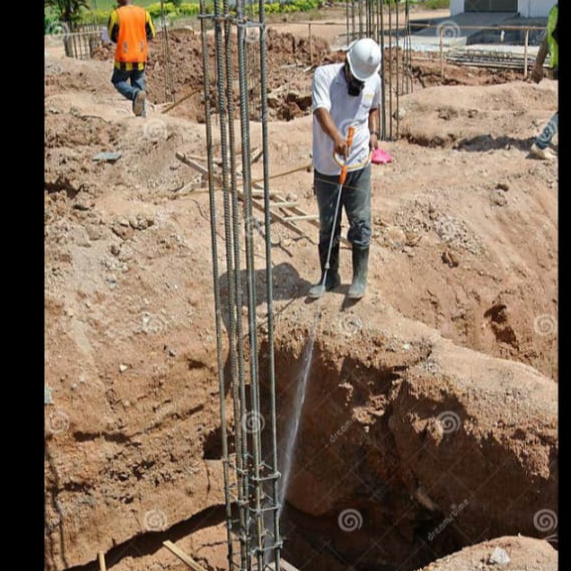
Anti termite pre construction treatment
The pre-constructional soil treatment must be applied up to the plinth level of the substructure during construction.
It includes soil treatment with authorised chemicals in water emulsion in foundation trenches for columns, plinth beams, plinth filling, wall-floor joints, expansion joints, and other stages as specified in IS 6313 Part-II 2013.
TIME OF APPLICATION OR WHEN TO APPLY ANTI TERMITE PROCEDURE ON SOIL:
- Soil treatment for anti termite should begin when foundation trenches and pits are ready.
- After the chemical emulsion has been absorbed by the soil and the surface is completely dry, mass concrete should be laid.
- When it is raining or the soil is wet with rain or sub-soil water, treatment should be avoided.
- The above rules also apply to the treatment of the filled earth surface inside the plinth area prior to installing the floor subgrade.
- The treated soil barriers must not be disturbed once they have been established.
- If treated soil barriers are accidentally disrupted, immediate actions must be taken to restore the barrier system’s continuity and completeness.
Procedure For Pre Construction Anti Termite Treatment:
The surface of the ground should be dry and clean.
The chemical should be injected three times in a certain order into the ground.
Firstly, the earth’s surface shall be drilled in 12mm diameter and 300mm deep at 150mm intervals below the PPC. The chemical should be administered at a rate of 5 litres per square metre.
Secondly, the building’s substructure, which is surrounded by earth, must be treated with the chemical at a rate of 7.5 Liters per square metre. The chemical will be injected 450mm deep and 150mm away from the substructure at this point.
Lastly, before installing the flooring, the inner plinth wall section should be backfilled with good soil and properly compacted. As previously stated, the chemical treatment will be completed at a rate of 5 litres per sqm.
Pre Construction Anti Termite Treatment Chemical Composition:
For anti-termite treatment chemicals used as per IS 8944 are:
- Imidacloprid 30.50 % SC
IS Standards Used For Anti Termite Treatment:
| IS CODE | DESCRIPTION |
|---|---|
| IS 6313 Part I | Constructional Measure |
| IS 6313 Part II | Pre-construction Anti Termite measure |
| IS 6313 Part III | Treatment for Existing building |
What is Chemical Barrier in Pre Construction Anti termite treatment?
The layer of chemically treated soil that comes into direct contact with a building’s foundation and floor structure and kills or repels termites, producing a termite-proof barrier.
What is Soil Treatment in Pre Construction Anti termite treatment?
Soil Treatment is a method where Anti termite chemicals are applied to the soil next to and beneath a structure as part of a chemical barrier that is either fatal or repellant to termites.
This is a method in which a building’s soil is treated with chemicals during the early stages of development.
Anti Termite treatment for RCC Foundation:
The treatment of reinforced cement concrete (RCC) foundations must be at a depth of 500mm below the ground level, unless the ground level is increased or decreased after the foundations have been cast by filling or cutting.
The 500mm depth should be calculated using the new soil level created by the above-mentioned filling or cutting, as well as soil in direct contact with the RCC vertical surface.
The rate of treatment for foundations is 7.5 litre per square meter.
Anti Termite treatment for foundation trenches made for Masonry walls & Basement:
The chemical should be applied to the bottom surface of the foundation and the foundation sides up to a height of about 300 mm of excavations created from masonry foundations and basements at a rate of 5 litres per square metre of surface area.
Anti Termite Treatment to Vertical Backfilled Soil along masonry Foundation/ retaining wall:
The backfill in contact with the foundation structure must be treated at a rate of 7.5 litres per square metre of the vertical surface of the sub-structure for each side of the foundation after the masonry foundations and basement retaining walls have been constructed.
The soil filling is done in layers, and the treatment is done in steps as well. The chemical solution must be applied to the masonry surfaces so that the ground in contact with them is adequately treated.
Anti Termite treatment of top Surface of Plinth Filling:
Before the sand bed or subgrade is placed, the top surface of the consolidated earth inside plinth walls must be treated with chemical emulsion at a rate of 5 l/m2.
This treatment must also be applied to the DPC installed on the plinth wall.
If the filled earth has been sufficiently compacted and the emulsion is not seeping into the soil, holes up to 50 to 75 mm deep at 150 mm centres both ways can be drilled on the surface with 12 mm diameter mild steel rod to allow the chemical emulsion to sweep into the soil.
Anti Termite treatment at Junction of the wall and the floor:
A short channel is used to carry out the anti-termite treatment at the wall’s junction. The rod holes in the channel up to the ground level 150 mm apart and the iron rod should be moved in backward and forward to create hole in the earth and chemical emulsion poured along the wall at the rate of 7.5 l/m2 of vertical wall or at the column surface so chemical will reach the soil right to the bottom (this must be done before laying the sub-grade).
After the anti-termite treatment is finished, the soil should be compacted well.
Anti Termite treatment of Soil along External Perimeter of Building:
After the construction is finished, the soil along the building’s external perimeter should be rodded at 150 mm intervals and to a depth of 300 mm. To make holes in the compacted earth, the rods should be pushed back and forth parallel to the wall in the earth, and chemical emulsion should be poured along the wall at a rate of 7.5 litre per square metre of the vertical surface. The ground should be compacted after the treatment.
Anti Termite treatment of Soil Surrounding Pipes, Wastes and Conduits:
When external work such as pipes, wastes, and conduits contact the soil inside the foundations, the soil surrounding each such pipe, waste, or conduit must be loosened for a distance of 150 mm and to a depth of 75 mm before treatment may begin. When pipes, wastes, and conduits penetrate the soil outside the foundation, they must be treated identically at a distance of above 300 mm unless they are 75 mm clear of the building’s walls.
Anti Termite treatment for Expansion Joints:
When doing the therapy below, pay specific attention to the soil underlying these joints. After the sub-grade has been placed, this treatment should be extended by treating through the expansion joints at a rate of 2 litres per linear metre.
- CATEGORY: Pest Control
- SUB CATEGORY: Anti Termite Treatment